

Photography by Guy Hand
James Beard Award-winning Chef Kris Komori sees plating as an integral part of his cooking, shaped by aesthetics, experience and the way a dish is meant to be eaten.
His tips for plating at home: heat your sides so they hit the plate first, place food just off-center, slice and fan your steak, drizzle sauce around the plate and garnish with whole herb leaves.

Chef Kris Komori
Chef Kris Komori leads the kitchen at KIN, where each tasting menu unfolds as a seasonal progression of dishes. Named the 2023 James Beard Best Chef: Mountain, he has spent nearly two decades studying the visual language of food, a fascination that began with a plating project in culinary school. Chef Komori menus Snake River Farms beef and pork at KIN.
 SRF Pork Shoulder. Brussels sprouts. Cabbage. Amaranth. Oak.
At his restaurant, KIN, each tasting menu unfolds as a progression. A dish arrives, then another, each one distinct but connected by a common story. The ingredients change with the seasons. So do the colors, textures and compositions. What ties them together is a deliberate sense of harmony.
The art of visual storytelling has been a longtime exploration for Chef Komori. His fascination with plating began in culinary school, where he chose it as an extracurricular project and began studying the photos in cookbooks. He initially reviewed books from the ’70s and ’90s while also examining the contemporary work of emerging chefs such as Grant Achatz of Alinea. “I didn’t even read the ingredients,” recalls Komori. “I just looked at the plating, scanned the images and kept a folder on my computer.”
That curiosity expanded beyond cookbooks. Komori began studying art books, drawing connections between the work of visual artists and the way chefs compose food on a plate. He also looked at chefs from different eras and their approach to plating, absorbing what appealed to him and questioning what didn’t.
How Chef Kris Komori Developed His Plating Style
He explored a range of styles, from the old-school French influences of Julia Child to the architectural, geometric techniques of Charlie Trotter. Later, as chefs such as René Redzepi and Noma began reshaping the look of fine dining, Komori watched with a more experienced eye.
Scandinavian plating retained precision but felt less rigid, incorporating natural materials such as rocks and shells into the composition. Through all of it, Komori was developing a visual language of his own.
“My style has evolved and shaped over time,” he explains. “I do lean toward minimalism, trying to be asymmetric, a little of Eastern art aesthetic as well. So for me it’s a balance of all of them.”
At KIN, that balance is particularly important because a tasting menu is not simply a collection of individual dishes. The plates must work together.
“You don’t want one dish that just looks totally different from the others unless it’s built into the story,” Komori says. “You don’t want to be repetitive on color, tone and things like that.”
 Chef Komori plating for an event.
 SRF Beef Coulotte. Squash blossom. Cherry. Basil. Popcorn.
Why Color and Seasonality Matter in Food Plating
That makes seasonality as much a visual consideration as a culinary one. In early spring, the kitchen might find itself surrounded by bright shades of green. Summer and fall bring oranges, yellows and reds. Winter moves toward whites, purples and deeper, darker tones from braised foods. The limitation is part of the challenge. Unlike a painter, a chef doesn’t have every color available.
“We don’t have natural shades of blue, for example,” Komori explains.
Instead, the kitchen works with what the landscape provides, finding variety within those seasonal palettes. A dish might be largely composed of a single color, with one course dominated by yellow and the next by orange. The goal isn’t to make every plate look different simply for the sake of variety. It’s to create a visual progression that feels intentional.
The same thinking applies to the physical composition of a dish. Komori tells his cooks to visualize what a plate will look like before they begin making it. But food, unlike manufactured objects, doesn’t always cooperate. Vegetables have irregular shapes. Ingredients vary from one piece to the next.
“If you want to make perfect circles, you’ve got to punch it out with a ring mold,” he says. “Otherwise, it’s going to look like you tried to make a circle.”
There is beauty, too, in allowing an ingredient to remain what it naturally is. “If you let something be its natural shape, then that’s what it’s going to be,” he says. For Komori, precision is a tool, not the ultimate goal. A dish should not feel disconnected from the food itself.
“We want food on the plate to look different, to look like something you wouldn’t do at home,” he clarifies. “But we also want it to connect.” That connection is where plating becomes part of cooking rather than decoration.

How to Plate Food at Home: 5 Tips From Chef Komori
- Start with the sides: Potatoes hold longer than steak. Heat them so they’re very hot. Have them hit the plate first.
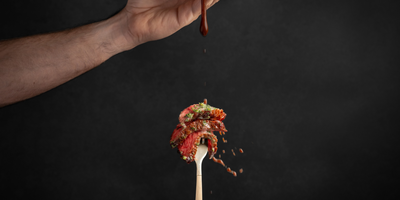
- Drizzle the sauce: Drizzle sauce around the plate.
- Go off-center: Place food just off-center.
- Slice and fan: Don’t serve the steak whole. Slice it, then shingle and fan them out to create a more appetizing visual.
- Finish fresh: Garnish with whole herb leaves saved from the sauce.
How Plating Affects the Way Food Tastes
Komori approaches the appearance of a dish much as he approaches its flavor. Is it balanced? Does it need acid? Does it need freshness? Is there enough textural contrast? Those questions can apply equally to the palate and the eye.
The visual equivalent of flavor might be color. A dish can taste exactly right and still need something. “We say the same thing to plating, right? This looks drab, it needs a pop of color,” he says.
Even the arrangement of the food can influence how the dish tastes. Komori considers what the first few bites should be like and how the components come together. Smaller pieces can allow more ingredients to arrive in a single bite. Larger pieces create a different experience.
“A lot of the plating structure depends on how you want to eat the dish,” he says.
At KIN, that consideration extends beyond the plate itself. The tasting-room experience begins before the food arrives, with phone calls to learn guests’ names and food allergies, servers learning the stories behind the dishes and all the small details that shape an evening.
“It’s the result of experience for me,” Komori reflects. “All the details help us reach more customers and create a personal experience.”
For a chef who has spent nearly two decades studying the visual language of food, perhaps the most important lesson is that there is no single formula.

SRF Flat Iron. Twice-baked fingerling potato. Carrot. Umeboshi. Blossoms.
Why Sauce Is the Secret to Beautiful Plating
Komori encourages young cooks to study, experiment and practice. One of his favorite exercises is working with sauce. At KIN, sauce is a constant presence, and its viscosity, texture and application can dramatically change a plate.
“The sauce is our medium, just like an artist uses paint,” he says.
He learned that lesson himself during downtime in restaurant kitchens, practicing circles with sauce until he could make them quickly and consistently. Twenty years later, the muscle memory remains.
But technique is only part of the equation. Komori still believes in experimentation. “Try something, look at it and if you don’t like the results, wipe the plate and try again,” he states.
“It’s a process,” he notes. And there is freedom in remembering what happens to every plate eventually. “We take what we do very seriously, but we don’t take ourselves too seriously,” Komori says. “We want it to look appealing, but what we make is meant to be eaten and disappear.”

SRF Beef Coulotte. Lobster and Pioppino Mushrooms. Cayenne. Ash.
Komori frequently asks the artists displaying work at the restaurant, “How do you know when a piece of art is finished?” The answers he receives are varied, but for his culinary art there is a distinction. “What we make is meant to be eaten,” he says.
That may be the most liberating part of plating. A dish doesn’t have to be perfect forever. It only has to be right for this moment, this table, this guest.
Tomorrow, there is always another plate.
Frequently Asked Questions About Food Plating
Who is Chef Kris Komori?
How do you plate a steak like a chef?
Does plating affect how food tastes?
Shop the Cuts Chef Komori Uses at KIN
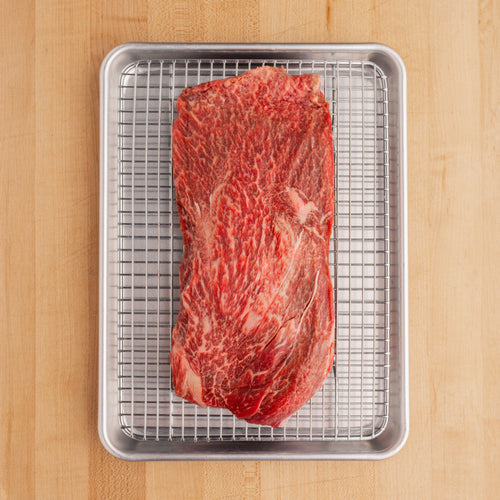
Bring restaurant-quality plating home with the Snake River Farms cuts featured on Chef Komori’s plates: American Wagyu Coulotte, American Wagyu Flat Iron and Kurobuta Pork Roasts.